Green Garbage Bags: India’s Garbage Crisis Just Got a Wake-Up Call: Are You Ready?
Let’s be real for a moment.
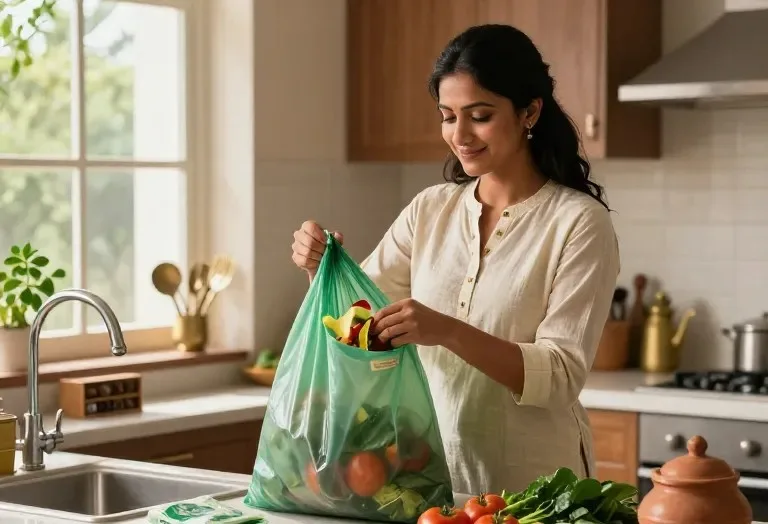
When was the last time you actually thought about the humble garbage bag sitting under your kitchen sink? You grab a roll, rip one off, line the bin, and forget about it until it’s overflowing with onion peels, tea leaves, and whatever else your household throws at it.
But here’s the uncomfortable truth that every Indian household needs to hear right now: that flimsy, black bag you’ve been using for years just became illegal.
Well, not exactly illegal – but the rules of the game have changed dramatically.
On January 30, 2026, the Government of India notified the new Solid Waste Management Rules, 2026, set to take effect from April 1, 2026 . This isn’t just another government circular destined to gather dust. This is a fundamental shift in how every Indian household, colony, and business must handle waste.
Four streams of mandatory segregation at source are now the law of the land: wet waste, dry waste, sanitary waste, and special care waste . And if you’re a bulk waste generator (think residential societies, commercial complexes, or institutions generating over 100 kg of waste daily), you’re now required to process wet waste on-site .
But here’s the million-rupee question: How do you segregate and dispose of waste properly without the right tools? The answer starts with one simple but critical choice: your ecofriendly garbage bag.
The India garbage bag market is projected to grow from $435.36 million in 2024 to $766.14 million by 2033, with biodegradable and compostable materials leading the charge . And for good reason -consumers like you are waking up to the fact that traditional plastic bags are environmental disasters that take centuries to decompose, fragmenting into microplastics that poison our soil and water .
But let’s address the elephant in the room: Do ecofriendly garbage bags actually work? Will they hold up to Indian household realities – the oily curry leftovers, the sharp fish bones, the heavy wet waste that makes cheaper bags surrender instantly?
Let’s track down the 7 best ecofriendly garbage bags available in India right now—bags that are strong, reliable, and genuinely good for the planet.
🔥 NEW LAW ALERT: Starting April 1, 2026, improper waste disposal could mean penalties. Don’t get caught unprepared. Check out these BPI-certified compostable bags before prices go up →

Spiritual T-Shirts for Women
Why Your Garbage Bag Choice Matters More Than Ever
The New Legal Reality: Solid Waste Management Rules, 2026
Before we dive into products, you need to understand what’s changed – and why your choice of ecofriendly garbage bag is now a compliance issue, not just an environmental one.
The Ministry of Environment, Forest and Climate Change (MoEF&CC) notified the Solid Waste Management Rules, 2026, which will replace the decade-old regime effective April 1, 2026 . Here’s what you need to know:
Four mandatory waste streams at source:
- Wet waste (biodegradable): Kitchen waste, food scraps, garden waste
- Dry waste (recyclable): Paper, plastic, metal, glass
- Sanitary waste: Diapers, sanitary napkins (must be wrapped and marked)
- Special care waste: Domestic hazardous waste like batteries, CFL bulbs
What this means for you:
If you’re a household, you must segregate. If you’re part of a residential society or commercial establishment with a floor area of 20,000 sq m+, water consumption of 40,000 litres/day+, or waste generation of 100 kg/day+, you’re classified as a bulk waste generator and must process wet waste on-site .
But here’s the kicker—proper segregation and processing require proper tools. You can’t just toss wet waste into any old bag and call it a day. If you’re composting or sending waste to municipal facilities, you need bags that actually break down as intended.
This isn’t just theory anymore. Cities like Bhubaneswar are already enforcing these rules strictly. The Bhubaneswar Municipal Corporation recently directed all fish, meat, and poultry vendors to store waste only in biodegradable bags of at least 120 microns and use leak-proof bins with tight lids—with threats of license suspension for non-compliance. The message is clear: ecofriendly garbage bags are no longer optional. They’re mandatory.
The Environmental Imperative: Beyond Government Rules
India generates over 62 million tonnes of waste annually, with only about 70% collected and a mere 20% processed . The rest ends up in landfills—massive mountains of garbage that leach toxins into groundwater and emit methane, a greenhouse gas 25 times more potent than CO2.
Traditional plastic garbage bags are made from polyethylene, a petroleum-based material that takes 20 to 500 years to decompose . And even when they finally break down, they don’t disappear—they just fragment into microplastics that contaminate everything.
But here’s the good news: the ecofriendly garbage bag revolution is here, and India is at the forefront.
The biodegradable packaging market in India was valued at about $3.51 billion in 2024 and is expected to reach $5.59 billion by 2033 . The government’s Plastic Waste Management Rules, 2016, and the Extended Producer Responsibility (EPR) framework are pushing manufacturers toward sustainable practices .
And Indian innovators are answering the call—from NaturTrust’s BPI-certified compostable bags made in Greater Noida to BioReform’s Hyderabad-based biopolymer technology that decomposes within six months to Ecoline Exim’s jute and cotton alternatives from West Bengal .
Check out the best spiritual gifts for Mom’s Birthday here.
The Consumer Reality: Do Green Bags Actually Work?
Now for the question everyone asks: Are ecofriendly garbage bags strong enough for Indian households? The short answer: Yes, absolutely- if you choose the right ones. The key is understanding what you’re buying. Not all “green” bags are created equal, and knowing the difference between true compostable bags and greenwashed impostors is crucial.
⚠️ WARNING: “Not all bags are truly bio-degradable”. Always look for genuine certifications like BPI or TUV. Skip the greenwashing—get certified compostable bags here →
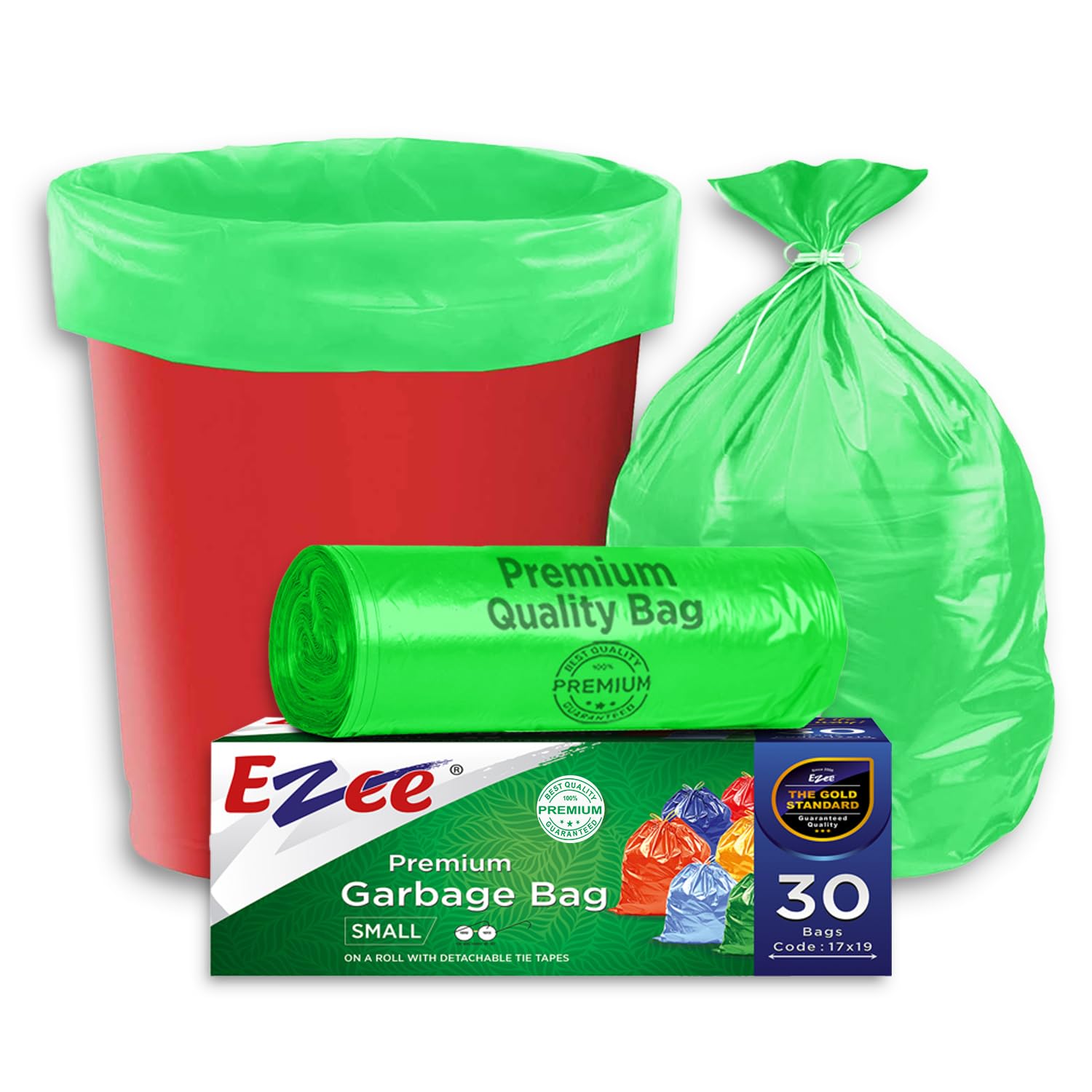
Net Quantity: 180.00 Count
Uses: Animal Waste, Food Waste, Garbage Waste
Understanding Ecofriendly Garbage Bag Terminology
Before we get to the product recommendations, let’s decode the jargon. When shopping for ecofriendly garbage bags in India, you’ll encounter several terms—and not all mean what you think.
Biodegradable vs. Compostable vs. Oxo-Biodegradable
| Term | What It Actually Means | The Truth |
|---|---|---|
| Biodegradable | Breaks down over time | Vague, unregulated term. Could take decades. |
| Compostable | Breaks down into organic matter under specific conditions | Must meet standards like ASTM D6400. Industrial vs. home matters. |
| Oxo-biodegradable | Plastic with additives that accelerate fragmentation | Greenwashing! Creates microplastics, banned in EU. |
Expert take: According to Lyall Mabin, co-founder of sustainable tips site Sustainable Jungle, “It’s good to know the difference between these biodegradable bags and bags made of petrochemical-based plastic—which are usually found in the supermarket and marketed as ‘ecofriendly.’ These degrade into microplastics faster, so it’s really just greenwashing” .
Material Matters: What Are Ecofriendly Bags Made From?
The best ecofriendly garbage bags are made from:
- Cornstarch/PLA (Polylactic Acid): Derived from fermented plant starch (usually corn)
- PBAT: A biodegradable polymer that adds flexibility and strength
- Plant-based biopolymers: Proprietary blends like BioReform’s technology
- Recycled materials: Some manufacturers use recycled content, though this is different from compostable
Thickness and Strength: The Indian Reality
Indian households generate heavy, wet waste—think vegetable peels, leftover dal, tea leaves. Your bags need to handle this without tearing.
- 36 microns is a common certified thickness for compostable bags
- 120 microns is required for certain applications like meat/fish waste under BMC rules
- Higher micron generally means stronger, but certified compostable bags at 36 microns perform well for household use
💡 PRO TIP: For everyday kitchen waste, 36-40 micron certified compostable bags work great. For meat, fish, or construction debris, go heavier. Shop by thickness and certification →
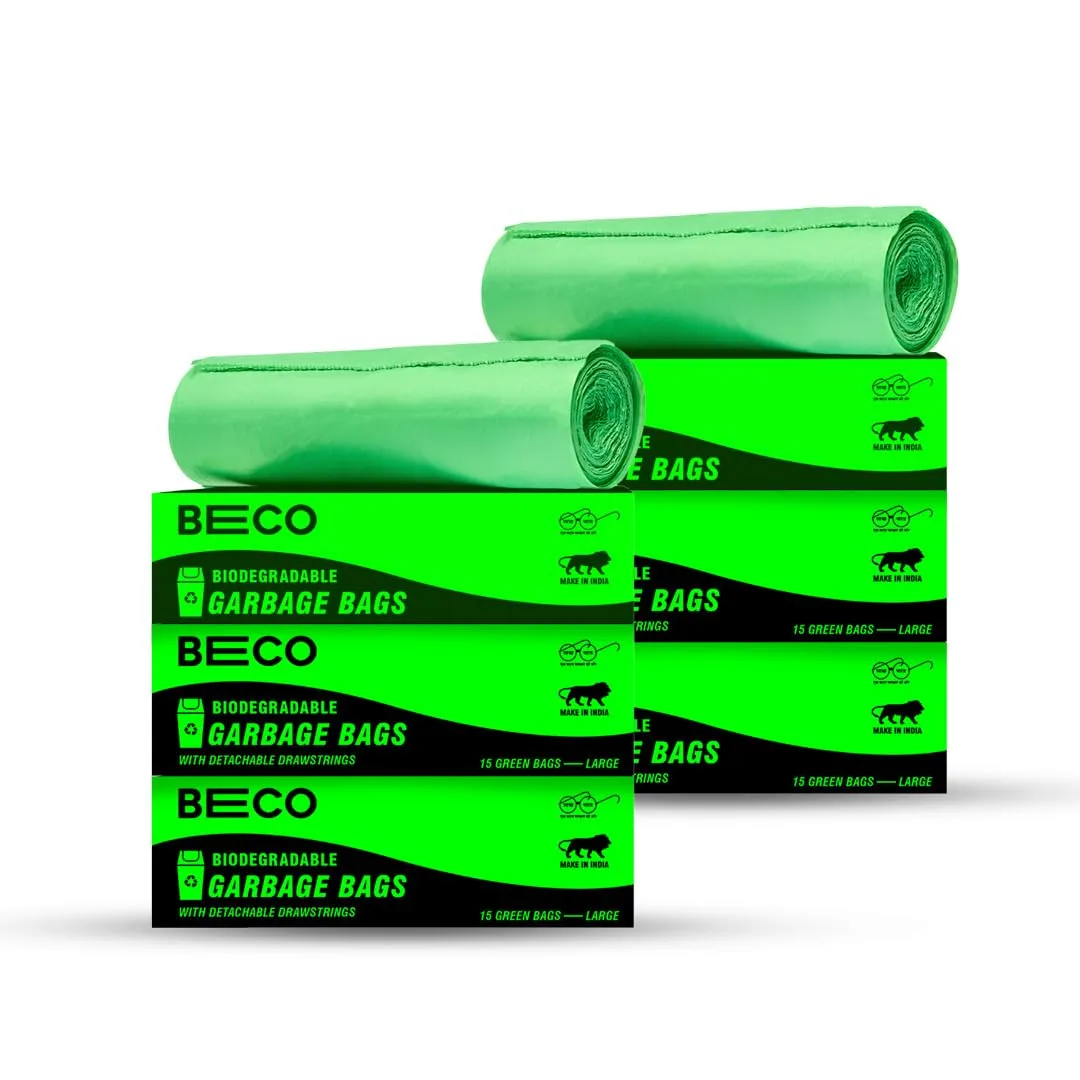
Net Quantity: 90.00 Count
Recommended Uses For Product
Recyclable Waste
7 Best Ecofriendly Garbage Bags Available in India
Based on extensive research, certification verification, and real customer reviews, here are the top ecofriendly garbage bags you can buy in India right now.
Beco Eco-Friendly Bags
Net Quantity: 90.00 Count
Uses: Recyclable Waste
Ezee Premium Eco Friendly Large Garbage Bags
Net Quantity: 180.00 Count
Uses: Animal Waste, Food Waste, Garbage Waste
Presto! Amazon Brand
Net Quantity: 130 Count
Uses: Multi-Purpose Use
Kachra Sack Garbage Bags
Net Quantity: 180 Count
Uses: Office
TRIBHU Eco-Friendly Garbage Bags
Net Quantity: 60 Count
Uses: Food Waste
HEAN Hygiene Bio Waste Semi Fresh Eco-Friendly Bags
Net Quantity: 30 Count
Uses: Biohazard Waste, DRY WASTE
ECO Friendly Garbage Bag
Net Quantity: 40 Count
Uses: Kitchen, Hotels, and Hospital
How to Choose the Right Ecofriendly Garbage Bag for Your Home
Understand Your Waste
Before buying, audit your household waste:
- What’s in your bin? Mostly vegetable peels and food scraps (wet waste)? Dry packaging? Sharp items?
- How heavy does it get? Daily kitchen waste vs. weekly deep cleaning
- Where does it go? Municipal bin? Compost pile? Garden waste?
The rule: Wet, heavy, or sharp waste demands stronger bags. Dry waste can use lighter options.
Check Your Local Requirements
With the new Solid Waste Management Rules, 2026 taking effect April 1, 2026, municipalities may have specific requirements . Some cities like Bhubaneswar already mandate 120-micron biodegradable bags for certain waste types . Call your local municipal corporation or check their website for specific guidelines.
Look for Legitimate Certifications
This cannot be overstated: Don’t trust marketing claims. Trust certifications.
On Amazon.in, search for:
- “BPI certified compostable bags”
- “ASTM D6400 certified”
- “TUV certified compostable”
- “Home compostable” (if you have a home compost)
NaturTrust’s BPI listing confirms their 36-micron kitchen food waste bags meet strict standards . This is what you want.
Match Bag to Room
Consider using different bags for different areas:
| Room | Recommended Bag Type |
|---|---|
| Kitchen (main bin) | Heavy-duty compostable |
| Bathroom | Smaller certified compostable |
| Home office | Budget compostable or oxo (if budget tight) |
| Garden | Lawn and leaf compostable bags |
| Shopping | Reusable jute/cotton (Ecoline Exim) |

Spiritual T-Shirts for Women
Store Properly
Ecofriendly bags are more sensitive to environmental conditions than plastic. Store them:
- In cool, dry places
- Away from direct sunlight
- Not in hot garages or damp basements
Heat and moisture can weaken bioplastics over time.
Test One Box First
Before committing to bulk purchases, buy one small pack and:
- Use it in your kitchen for a week
- Fill it normally and carry to disposal
- Note any tears, leaks, or handling issues
💡 SMART SHOPPING: Start with a small pack to test before buying in bulk. Grab a trial pack of ECO Friendly Garbage Bags →
India’s Ecofriendly Revolution
Market Growth and Momentum
The India garbage bag market is projected to reach $766.14 million by 2033, growing at a CAGR of 6.5% . The shift toward eco-friendly and biodegradable options is accelerating due to increasing environmental awareness and government regulations .
Government Push
The Plastic Waste Management Rules, 2016, regulate the manufacture, sale, and use of plastic bags, specifying thickness and color requirements to ensure recyclability . The Extended Producer Responsibility (EPR) framework assigns responsibility to producers for managing waste generated from their products, incentivizing sustainable practices .
The new Solid Waste Management Rules, 2026, take this further by mandating four-stream segregation and placing larger onus on bulk waste generators .
Indian Innovation on the Rise
- NaturTrust (Greater Noida) brings BPI-certified compostable bags to Indian consumers
- BioReform (Hyderabad) develops proprietary biopolymer technology gaining international recognition
- Ecoline Exim (Kolkata) exports jute and cotton bags to 27+ countries and just listed on NSE Emerge
These aren’t just importers selling foreign products. These are Indian companies building world-class sustainable solutions.
Challenges Remain
The market still faces hurdles:
- Lack of awareness about proper waste disposal practices
- Inadequate waste management infrastructure in many areas
- Price sensitivity of Indian consumers
- Highly fragmented market with numerous small, unorganized players
But the trajectory is clear: ecofriendly garbage bags are the future, and that future is arriving fast.
Frequently Asked Questions
Q: Are ecofriendly garbage bags really better for the environment?
A: Yes—but only if they’re genuinely compostable and disposed of correctly. Certified compostable bags that go to industrial composting facilities break down into water, CO2, and humus without leaving microplastics. However, “oxo-biodegradable” bags are greenwashing—they just fragment into microplastics .
Q: What’s the difference between biodegradable and compostable?
A: “Biodegradable” is an unregulated term that just means something will eventually break down—could be 500 years. “Compostable” means it meets specific standards (like ASTM D6400) to break down into organic matter within a specific timeframe under specific conditions .
Q: Can I put compostable bags in my home compost?
A: Only if they’re specifically labeled “home compostable” with certifications like TUV Home Compost. Most compostable bags require industrial facilities with higher heat and microbial activity.
Q: Why do ecofriendly bags cost more?
A: Plant-based materials (cornstarch, PLA, PBAT) are more expensive to produce than petroleum-based plastic. However, many users find they use fewer bags because they’re stronger, offsetting some cost difference. Think of it as an investment in the planet.
Q: Are these bags strong enough for Indian household waste?
A: Yes—the good ones are. ECO SOUL reviewers specifically confirm these bags handle heavy waste without tearing . NaturTrust’s 36-micron BPI-certified bags are tested for kitchen food waste .
Q: What thickness should I buy?
A: For everyday kitchen waste, 36-40 microns works well. For meat, fish, or construction debris, go heavier (120 microns as mandated by some municipalities) .
Q: How do I know if a bag is truly compostable?
A: Look for third-party certifications: BPI, TUV Austria, EN13432, ASTM D6400. If you don’t see these logos, the claims may be greenwashing. NaturTrust’s BPI listing is a gold standard example .
Q: What about Shalimar’s oxo-biodegradable bags?
A: They’re a budget-friendly transition option, but true eco-warriors avoid oxo. As one ECO SOUL reviewer noted, oxo bags “claim to be compostable but are actually a scam” . If you can afford certified compostable, that’s the better choice.
Q: Where can I buy these bags?
A: All the bags in this guide are available on Amazon.in. Use the links provided to check current prices and availability.
Q: Will these bags work for my wet waste?
A: Yes—that’s what they’re designed for. NaturTrust specifically lists “Kitchen Food Waste Bags” in their BPI certification . ECO SOUL reviewers confirm they handle everyday kitchen waste well .
Which Ecofriendly Garbage Bag Should You Choose?
After extensive research, certification verification, and real customer review analysis, here’s our bottom-line recommendation:
For Most Indian Households: Tribhu Eco-Friendly Compostable Trash Bags
- Proven track record with real Indian consumers
- Consistently praised as the sturdiest option
- Handles heavy wet waste without tearing
- Worth the premium price for reliability
Shop Tribhu Eco Friendly Garbage Bags on Amazon →
For BPI-Certified Peace of Mind: Eco Soul Compostable Bin Liners
- Officially BPI-certified (the gold standard)
- Made in India with international credibility
- 36 microns tested to meet strict standards
- Multiple sizes available
For Budget-Conscious Buyers: Shalimar (Oxo-Biodegradable)
- Best value at under ₹500 for 120 bags
- Good strength and durability
- Acceptable first step away from conventional plastic
- 10,000+ ratings with positive feedback
For Zero-Waste Warriors: GreenDot Biopack Bags
- Eliminate disposable entirely
- GOTS-certified organic options
- Made in India, exported globally
- Perfect for shopping and storage
Explore GreenDot Biopack collection →

Spiritual T-Shirts for Women
Your Choice Matters More Than Ever
Here’s the truth, and it’s one every Indian household needs to hear: Starting April 1, 2026, how you handle waste isn’t just a personal choice—it’s the law.
The Solid Waste Management Rules, 2026, mandate segregation at source. Cities like Bhubaneswar are already enforcing strict rules requiring biodegradable bags for certain waste types, with license suspensions for non-compliance .
But beyond the law, there’s something deeper. When you choose a genuinely ecofriendly garbage bag—one with real certifications, proven strength, and actual environmental benefits—you’re not just buying a product. You’re voting for the kind of world you want to live in. You’re supporting Indian innovators like NaturTrust in Greater Noida, BioReform in Hyderabad, and Ecoline Exim in Kolkata. You’re telling manufacturers that greenwashing isn’t acceptable. You’re showing your family that sustainability matters.
And the good news? You don’t have to sacrifice quality to be green. Today’s best ecofriendly garbage bags are strong, reliable, and affordable. They hold up to real-world use—the heavy wet waste, the sharp corners, the daily grind of Indian household life. They resist tears and leaks. And most importantly, they don’t stick around for 500 years after you throw them away.
So next time you reach under the sink for a new liner, make the choice that aligns with your values. Choose a bag that does its job and disappears. Choose a bag that lets you sleep better at night.
Choose ecofriendly.
Your home will stay just as clean. Your conscience will be lighter. And the planet—our beautiful, battered, irreplaceable planet—will thank you.
Disclaimer: This article contains affiliate links. If you purchase through these links, we may earn a commission at no extra cost to you. All products are independently selected and reviewed based on certification verification, customer feedback analysis, and suitability for Indian households. Prices are approximate and may vary by seller and over time. Always check product certifications before purchasing.