
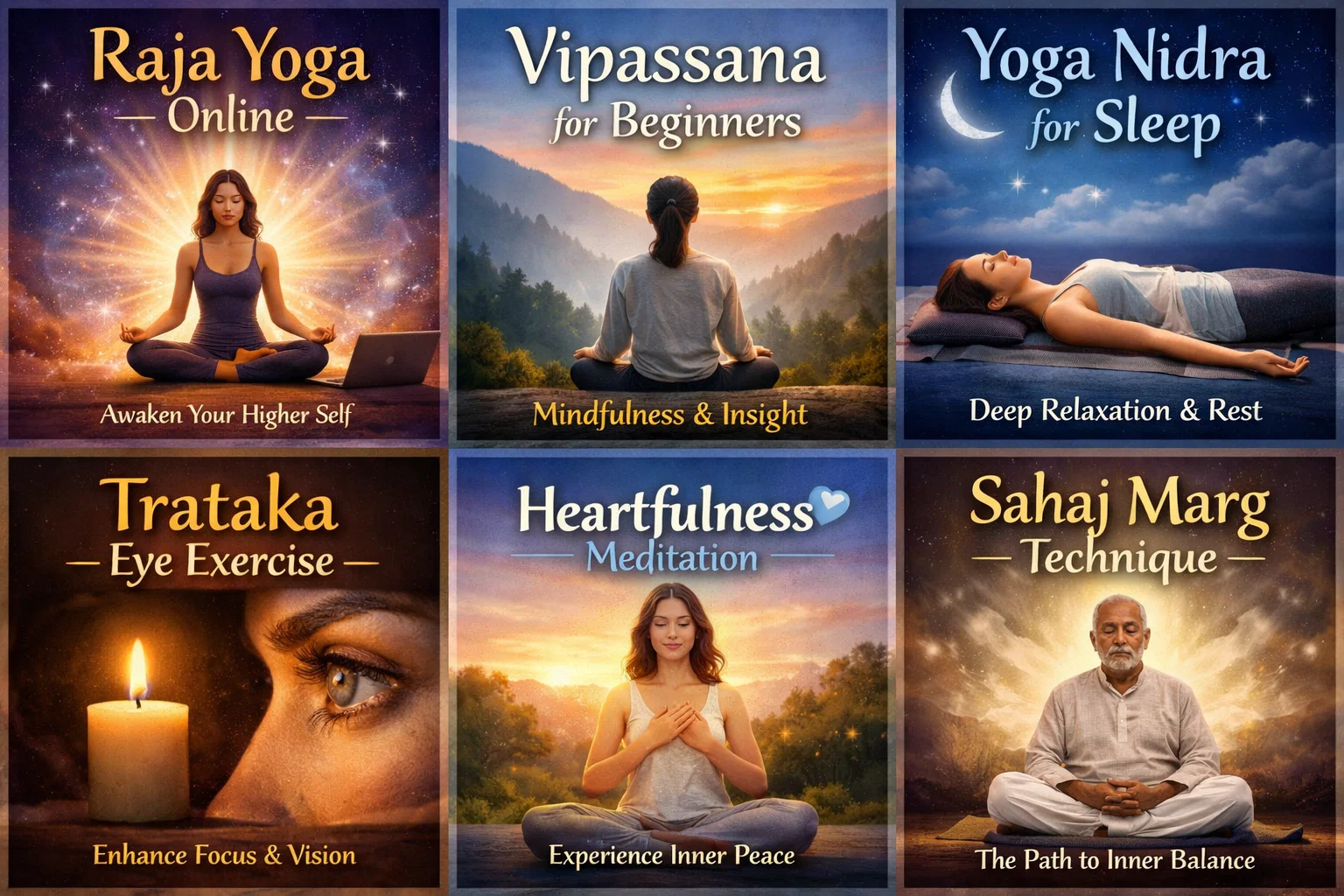
The Silent Epidemic of Failed Meditation Attempts
Close your eyes. Sit still. Breathe. Sounds simple, doesn’t it? Yet here you are, perhaps for the tenth, twentieth, or even hundredth time, trying to meditate and feeling absolutely nothing except the maddening chatter of your own mind.
You are not alone. In fact, research suggests that nearly 90% of people who attempt to learn meditation online give up within the first 30 days. Why? Because most people think meditation is just “sitting still and closing your eyes.” They are catastrophically wrong.
In ancient India, meditation was never a casual hobby. It was a precise science, a “technology” for the human mind, as rigorous as engineering, as systematic as mathematics. The sages of the Vedas, the Buddhas of ancient monasteries, and the yogis of the Himalayas didn’t just “sit and hope.” They followed structured, step-by-step frameworks that had been refined over thousands of years.
👉 Click Here to See Why Indians Are Finally Learning Meditation Online – The Right Way
The secret to success in 2026 is simple: you need to learn meditation online using authentic, structured frameworks – not vague advice, not spiritual slogans, but actual techniques with measurable outcomes.
In this guide, we will explore 7 ancient meditation techniques, each rooted in millennia of Indian wisdom, and pair them with the exact digital courses (from Udemy, Coursera, and specialist portals) that will help you master them.
No fluff. No vague spirituality. Just actionable, science-backed, ancient-tested methods. And yes, we’ve hand-picked the best courses so you can start your journey today.
Spiritual T-Shirts for Men. Best for Meditation and Yoga.
The Ancient Science of Meditation – What the Vedas Knew That We Forgot
1.1 Meditation Was Never “Just Sitting”
Before we dive into the techniques, let us correct a fundamental misunderstanding. In the Western world, and increasingly in modern India, meditation has been reduced to a generic term meaning “relaxation.” You put on some ambient music, close your eyes, and hope for the best.
But in the ancient Indian tradition, there is no single word “meditation.” Instead, there is a vast taxonomy of precise mental practices:
- Dhyana – Single-pointed focus on a single object or idea
- Dharana – Concentrated attention (the precursor to Dhyana)
- Samadhi – Absorption or union (the ultimate goal)
- Pratyahara – Withdrawal of the senses
- Yoga Nidra – Yogic sleep (conscious relaxation)
- Trataka – Gazing meditation
- Mantra Japa – Repetition of sacred sounds
- Vipassana – Insight into the true nature of reality
Each of these is a different technology for a different purpose.
⚠️ WARNING: Most “meditation apps” teach a generic, watered-down version that works for almost no one. Click here to learn the authentic techniques BEFORE you waste another year.
Beta Brainwave Entrainment Audio. 1A powerful 1-Minute soundwave that activates beta brainwaves.
1.2 The Three Brains: Why One Size Fits None
Here is the dirty secret that no meditation app will tell you: different people need different meditation techniques based on their dominant “brain type.” Ayurveda and ancient yogic texts classified human beings into three broad categories based on their doshas (mind-body types):
- Vata types (air + space) – Creative, anxious, scattered. They need grounding meditations like Trataka or Yoga Nidra.
- Pitta types (fire + water) – Ambitious, intense, competitive. They need cooling meditations like Vipassana or heart-centered practices.
- Kapha types (earth + water) – Calm, steady, but prone to lethargy. They need energizing meditations like Mantra or dynamic breathing.
If you are a Vata person trying to do a “do nothing” meditation, you will fail. If you are a Kapha person trying to do an intense Vipassana retreat, you will struggle. The solution? Learn meditation online by first understanding your constitution, then choosing the right technique.
1.3 The Modern Science: What fMRI Scans Reveal
Modern neuroscience has caught up with ancient wisdom. Using functional MRI (fMRI) and EEG technology, researchers have discovered that different meditation techniques produce measurably different brain states:
- Focused attention meditation (like Trataka or Mantra) strengthens the dorsolateral prefrontal cortex (responsible for concentration and willpower).
- Open monitoring meditation (like Vipassana) reduces activity in the default mode network (the brain’s “monkey mind” center).
- Compassion meditation (like Metta or Heartfulness) increases activity in the insula and temporal parietal junction (empathy centers).
This is not magic. This is neuroplasticity; the brain’s ability to rewire itself through repeated practice. And the best part? You can trigger these changes from the comfort of your home. You just need the right online course to guide you.
📦 Shop Neuroplasticity-Boosting Meditation Courses Here — Certified by global universities -Learn Meditation Online
Why 90% of People Fail to Learn Meditation Online
Let us name the enemy. Before we give you the solutions, let us diagnose why most people fail.
Failure #1: The “Watch Your Breath” Trap
The most common meditation advice is “just watch your breath.” For a beginner, this is like telling someone who has never swum to “just jump in the deep end.”
Without proper instruction, most people either:
- Fall asleep (because they are too relaxed)
- Get frustrated (because their mind wanders constantly)
- Hyperventilate (because they try to control the breath)
The Fix: Learn a structured technique that gives you a specific anchor; not just vague breath awareness.
Discover this amazing article on mindful gaming here. – Learn Meditation Online
Failure #2: No Progression Path
Most online meditation resources offer the same technique for Day 1 and Day 100. But meditation is a skill that requires progression, just like learning to play the guitar or speak a new language.
The Fix: Choose courses that offer day-by-day roadmaps with increasing difficulty.
Failure #3: No Accountability
When you meditate alone, there is no one to check if you are doing it correctly. No feedback. No correction. No motivation.
The Fix: Join courses with community forums, live Q&A sessions, or certification tracks.
Failure #4: The “Spiritual Bypass” Trap
Many online meditation resources are filled with vague spiritual jargon that sounds nice but provides no actionable instruction. “Become one with the universe” is not a technique.
The Fix: Choose courses that are practical, grounded, and measurable.
🔥 DEAL ALERT: Get Lifetime Access to Meditation Courses Online Here.
Discover the 4 ways to activate your Theta Wave.
7 Ancient Techniques to Learn Meditation Online
Here are 7 powerful meditation techniques, each rooted in ancient Indian wisdom, each validated by modern science, and each available through top affiliate courses you can enroll in today.
1: The “Warrior’s Focus” – Raja Yoga – Learn Meditation Online
The Ancient Wisdom
Raja Yoga – the “Royal Path” – is the meditation system described in Patanjali’s Yoga Sutras, one of the most important texts in Indian philosophy. Unlike Hatha Yoga (which focuses on the body), Raja Yoga focuses entirely on the mind.
If your mind feels like a “monkey” jumping from one thought to another – and let us be honest, whose doesn’t?- Raja Yoga is your solution. The system is built on the Eight Limbs of Yoga (Ashtanga):
- Yama (ethical restraints)
- Niyama (personal observances)
- Asana (physical posture – just enough to sit comfortably)
- Pranayama (breath control)
- Pratyahara (sense withdrawal)
- Dharana (concentration)
- Dhyana (meditation)
- Samadhi (absorption)
The Modern Science
A study published in 2021 found that just 8 weeks of Raja Yoga practice led to:
- Increased gray matter density in the hippocampus (memory center)
- Reduced cortisol levels (stress hormone)
- Improved performance on attention-based tasks
Course Name: “Yoga & Meditation: 21 Day First Step to Master Your Life”
Platform: Udemy
Best For: Absolute beginners, busy professionals, students
What You Get:
- 21-day structured roadmap
- 4+ hours of video content
- Downloadable worksheets
- Lifetime access
- Certificate of completion
👉 Click Here to Enroll in the Raja Yoga Course on Udemy. – Learn Meditation Online
Why It Works: Unlike generic meditation apps, this course provides a day-by-day progression that fits the busy Indian lifestyle. Each day builds on the previous, so you are never overwhelmed.
2: The “Mind-Hacker’s” Secret – Vipassana
The Ancient Wisdom
Vipassana – which means “to see things as they really are” – is one of the oldest meditation techniques in existence. It was the primary meditation taught by Gautama Buddha 2,500 years ago and has been preserved in an unbroken lineage ever since.
Unlike concentration practices (which focus on a single object), Vipassana teaches you to observe reality without reacting. You sit still and observe every sensation in your body – heat, cold, tingling, pulsing, itching – without judging, without craving, without aversion. It is the ultimate tool for emotional intelligence.
👉 Why top Indian entrepreneurs are turning to this 2,500-year-old technique to make better decisions.
Activate Your Billionaire Bridge Today
The Modern Science
Research from Harvard, MIT, and the University of Wisconsin has shown that Vipassana meditation:
- Reduces activity in the amygdala (the brain’s fear center)
- Decreases default mode network activity (the “monkey mind”)
- Improves emotional regulation and decision-making
- Reduces symptoms of anxiety, depression, and chronic pain
A 2022 study found that just 30 minutes of Vipassana-style practice daily for 8 weeks produced measurable changes in brain structure – including increased cortical thickness in areas associated with attention and sensory processing.
Course Name: “Meditation: A way to achieve your goals in your life“
Platform: Coursera (offered by KAIST – Korea Advanced Institute of Science and Technology)
Best For: Professionals, entrepreneurs, anyone dealing with stress
What You Get:
- 4-week structured program
- Video lectures from neuroscience experts
- Guided audio meditations
- Peer-reviewed assignments
- Shareable certificate from a top-50 global university
👉 Click Here to Enroll in the 20 Vipassana-Style Course on Coursera (Free Trial Available)
Why It Works: This course breaks down the complex Vipassana technique into practical, science-backed steps. You learn why the technique works, not just how to do it – which keeps you motivated when the practice gets difficult.
📦 Upgrade to the Full Mindfulness Specialization (4 Courses) – 50% OFF
3: “Psychic Sleep” – Yoga Nidra
The Ancient Wisdom
Yoga Nidra – or “yogic sleep” – is a state of consciousness between waking and sleeping. It was developed by the sages of the Tantric tradition and later popularized by Swami Satyananda Saraswati of the Bihar School of Yoga.
Here is the astonishing claim: 45 minutes of Yoga Nidra is equivalent to 3 hours of deep sleep. In a sleep-deprived India, where millions struggle with insomnia, restless nights, and chronic fatigue, this is a life-saver.
The Modern Science
Decades of research on Yoga Nidra have produced remarkable findings:
- A 2020 study found that Yoga Nidra significantly improved sleep quality and reduced insomnia severity in participants with chronic sleep disorders.
- Research using EEG has shown that Yoga Nidra produces theta brain waves (associated with deep relaxation and creativity) while keeping the practitioner conscious – a unique neurological state.
- A 2023 meta-analysis concluded that Yoga Nidra is effective for reducing anxiety, depression, PTSD symptoms, and chronic pain.
Course Name: “Yoga Nidra Teacher Training (Certificate)”
Platform: Udemy
Best For: Insomnia sufferers, high-stress professionals, yoga teachers
What You Get:
- 6+ hours of video content
- 30+ guided Yoga Nidra scripts
- Downloadable audio meditations (for personal practice)
- Certificate of completion (counts toward continuing education)
- Lifetime access
👉 Click Here to Enroll in the Yoga Nidra Course on Udemy (75% OFF) – Learn Meditation Online
Why It Works: Even if you don’t want to teach, this is the most comprehensive Yoga Nidra guide available online. The instructor walks you through the sankalpa (resolve), the body rotation, the breath awareness, and the withdrawal stages with precision.
🔥 SPECIAL OFFER: Buy Insomnia Relief Vicks ZzzQuil Natura Sleep Gummies – 15% OFF
Fall Asleep In 2 Minutes With This U.S. Marine’s “Tongue Trick”
4: Sound Science – Vedic Mantra Meditation
The Ancient Wisdom
In the Vedic tradition, the universe itself was created through sound. The sacred syllable OM (or AUM) is considered the primordial vibration from which all existence emerged. Mantra meditation uses specific sound vibrations – called Beej (seed) mantras – to clear the subconscious mind, balance the chakras, and elevate consciousness.
But here is the catch: pronunciation matters. A mispronounced mantra is like a misdialed phone number – it goes nowhere.
🔥 The “OM” Frequency: Are you pronouncing it wrong? Unlock the hidden power of sound today.
The Modern Science
The field of nada yoga (yoga of sound) is now being studied by acoustical physicists and neuroscientists:
- Research has shown that chanting OM produces vibrations at 432 Hz – a frequency found throughout nature (from the sound of the ocean to the resonance of the Earth itself).
- A 2018 study using fMRI found that OM chanting deactivates the limbic system (the brain’s emotional center) while activating areas associated with relaxation and focus.
- Mantra repetition has been shown to reduce heart rate, lower blood pressure, and decrease cortisol levels.
Course Name: “Mantra Meditation: Deepen Your Practice”
Platform: Udemy
Best For: Spiritual seekers, chant lovers, anyone interested in sound healing
What You Get:
- 3.5+ hours of video content
- Correct Sanskrit pronunciation guides
- Downloadable audio files of each mantra
- PDF guides to each mantra’s meaning and purpose
- Lifetime access
👉 Click Here to Enroll in the Mantra Meditation Course on Udemy (80% OFF)
Why It Works: Most online resources butcher Sanskrit pronunciation. This course was created by a native Sanskrit scholar and includes audio guides so you can hear the correct sounds. For genuine Indian spiritual seekers – or anyone who wants authenticity – this is essential.
📦 Get the Chi Manifestation Mantra Here.
Spiritual T-Shirts for Men
5: The “Third Eye” Activation – Trataka – Learn Mediation Online
The Ancient Wisdom
Trataka – or “candle gazing” – is one of the six purification techniques (Shatkarmas) described in the Hatha Yoga Pradipika, a classic 15th-century text. The practice is deceptively simple: you gaze at a single point (traditionally a candle flame, but also a black dot, a yantra, or the rising sun) without blinking, until tears flow.
But the effects are profound. Trataka is said to:
- Activate the Ajna chakra (third eye)
- Improve eyesight (both physical and “internal” vision)
- Enhance memory and concentration
- Develop intuition and psychic abilities
🔥 Beyond Sight: How “Gazing” can unlock your intuition and double your memory.
Daily Brain Audio – Memory & Focus (16 Sessions)
The Modern Science
Modern research has validated several of these claims:
- A 2021 study found that 8 weeks of Trataka practice significantly improved visual memory and attention span in school-going children.
- Ophthalmological research suggests that Trataka can reduce digital eye strain (a growing problem in the screen-addicted era) by improving the flexibility of the ciliary muscles.
- The practice has also been shown to reduce symptoms of insomnia and anxiety by calming the nervous system.
Course Name: “Trataka Meditation Masterclass”
Platform: Advaita Yoga
Best For: Students preparing for competitive exams, anyone with eye strain, spiritual seekers
What You Get:
- Step-by-step guides for candle, dot, and flame gazing
- Safety precautions (essential – Trataka done wrong can strain the eyes)
- Guided practice sessions
- Lifetime access
👉 Click Here to Enroll in the Trataka Course at Adwaityoga and Learn Meditation Online
Premium Meditation Programs for Consciousness & Brain Power
6: The Science of Well-Being – Mindfulness (The Modern Adaptation)
The Ancient Wisdom
While “Mindfulness” sounds Western, it is actually the modern adaptation of Sati – an ancient Pali word meaning “awareness” or “remembering.”
The Buddha taught Satipatthana (the Four Foundations of Mindfulness) as the direct path to liberation. The practice involves systematically observing:
- The body (kaya)
- Feelings/sensations (vedana)
- Mind/consciousness (citta)
- Mental phenomena (dhammas)
🔥The Yale Secret: Why the world’s most popular course is actually based on Ancient Indian Wisdom.
The Modern Science
This is the most researched meditation technique in the Western world:
- Dr. Jon Kabat-Zinn (founder of Mindfulness-Based Stress Reduction or MBSR) has published over 100 peer-reviewed studies showing the effectiveness of mindfulness for chronic pain, anxiety, depression, and stress.
- Dr. Richard Davidson at the University of Wisconsin has used fMRI to show that mindfulness practice changes the brain’s structure and function – a phenomenon called neuroplasticity.
- Yale University’s “The Science of Well-Being” – the most popular course in the university’s 300+ year history – is built on mindfulness principles derived from ancient Buddhist psychology.
Course Name: “The Science of Well-Being”
Platform: Coursera (offered by Yale University)
Best For: Skeptics, science-lovers, anyone who wants evidence-based happiness
What You Get:
- 10-week structured program
- Video lectures by Dr. Laurie Santos (Yale professor)
- “Rewirement” weekly challenges
- Peer-reviewed assignments
- Shareable certificate from Yale University
- Free audit option (paid certificate optional)
👉 Click Here to Enroll in Yale’s Science of Well-Being Course on Coursera (Free Audit Available)
Why It Works: This course bridges the gap between ancient wisdom and modern science perfectly. You learn the why (neuroscience, psychology) and the how (daily mindfulness practices). Over 1 million students have enrolled – making it the most popular online course of all time.
📦 Upgrade to the Yale Well-Being Specialization (3 Courses)
7: Heart-Centered Growth – Sahaj Marg (Heartfulness)
The Ancient Wisdom
Sahaj Marg – which means “Natural Path” – is a meditation system that focuses on the light in the heart. It was developed in the early 20th century by Ram Chandra of Shahjahanpur (known as Babuji Maharaj) and is now practiced by millions worldwide under the name Heartfulness.
Unlike breath-watching (which can feel mechanical) or mantra repetition (which can feel repetitive), Sahaj Marg invites you to gently feel the presence of divine light in the heart center.
🔥The Heart’s Secret: Unlock unconditional peace without leaving your desk.
The Modern Science
Heartfulness meditation has been the subject of several recent studies:
- A 2020 study found that Heartfulness practice significantly reduced perceived stress and burnout in healthcare professionals.
- Research using heart rate variability (HRV) monitoring has shown that Heartfulness increases vagal tone – a marker of the body’s ability to relax and recover from stress.
- A 2022 pilot study found that Heartfulness improved sleep quality, emotional regulation, and overall well-being in participants with anxiety.
Course Name: “Heartfulness Meditation: Introductory Series”
Best For: Emotional people, heart-centered individuals, those who find “breath-watching” too mechanical
What You Get:
- 1.5+ hours of video instruction
- Guided heart-centered meditations
- Downloadable audio files
- Access to global Heartfulness community (live online sessions)
- Lifetime access
👉 Click Here to Enroll in the Heartfulness Course on Udemy and Learn Meditation Online
📦 Emotional Intelligence: Cultivating Immensely Human Interactions Course by University of Michigan on Coursera
Which Platform Should You Choose To Learn Meditation Online?
Not all online learning platforms are created equal. Here is a detailed comparison to help you decide:
| Platform | Best For | Why Click? | Pricing | Certificate | Offline Access |
|---|---|---|---|---|---|
| Udemy | Practicality, variety, budget | Lifetime access for the price of a pizza! Courses as low as ₹455 ($5.50) | One-time payment (₹455-₹3,500) | Yes (completion) | Yes (mobile app) |
| Coursera | Credibility, university-backed degrees | Get a certificate from Yale, Harvard, or a Top-10 Global University | Subscription ($39-59/month) or free audit | Yes (shareable) | Yes (mobile app) |
| Sivananda Yoga | Authenticity, lineage | Pure, unadulterated Indian lineage – the real deal | $49-499 depending on course | Yes (registered) | No (live online) |
| Heartfulness App | Accessibility, community | 100% FREE – no excuse not to start | Free | No | Yes |
The 7-Day Jumpstart – Your First Week of Learning Meditation Online
Do not overthink this. The best time to start was 10 years ago. The second best time is today. Here is a simple 7-day plan to begin your journey:
| Day | Technique | Time Commitment |
|---|---|---|
| Day 1 | Raja Yoga (Introduction) | 20 minutes |
| Day 2 | Mindfulness (Body Scan) | 15 minutes |
| Day 3 | Trataka (Candle Gazing) | 10 minutes |
| Day 4 | Yoga Nidra (Guided Relaxation) | 20 minutes |
| Day 5 | Mantra Meditation (OM Chanting) | 15 minutes |
| Day 6 | Heartfulness (Heart Focus) | 15 minutes |
| Day 7 | Integration – Choose Your Favorite | 30 minutes |
Frequently Asked Questions (FAQ)
Q1: Can I really learn meditation online without a guru?
Yes – with the right structured courses. The ancient tradition emphasized guru-shishya parampara (teacher-student lineage), but modern technology has democratized access. The courses listed above are taught by authentic, lineage-holders (Indian yoga masters, Buddhist monks, university professors) who have adapted their teachings for the digital age.
Q2: How long does it take to see results?
- Immediate: Reduced stress, calmer mind (after 1 session)
- 2-4 weeks: Improved focus, better sleep
- 8 weeks: Measurable brain changes (neuroplasticity)
- 6 months: Lasting personality changes (reduced reactivity, increased compassion)
Q3: I have tried meditation before and failed. Why will this time be different?
Because you will choose a technique matched to your constitution (dosha) and follow a structured, day-by-day roadmap – not vague advice. The 90% failure rate is real, but it applies to people who “try” without a system. You now have a system.
Q4: Which course should I start with to learn meditation online?
For absolute beginners: Raja Yoga on Udemy (21-day roadmap)
For skeptics/scientists: Yale’s Science of Well-Being on Coursera (evidence-based)
For insomnia/stress: Yoga Nidra on Udemy (immediate relief)
For spiritual seekers: Mantra Meditation on Udemy (authentic Sanskrit)
Q5: Are these courses recognized internationally?
- Udemy certificates are not accredited but are accepted by many employers as evidence of continuing education.
- Coursera certificates are shareable on LinkedIn and recognized by global employers (especially Yale’s certificate).
- Sivananda certificates are registered with Yoga Alliance (the international yoga governing body).
Q6: Can I get a refund if I don’t like a course?
- Udemy: 30-day money-back guarantee
- Coursera: 14-day refund for subscription (free audit available – no risk)
- Sivananda: Varies – check their policy
Q7: I am a complete beginner. Will I understand the Sanskrit terms?
Yes – all the courses listed use plain English (and sometimes Hindi) explanations. Sanskrit terms are introduced gradually with clear definitions.
Q8: How much time do I need daily to learn meditation online?
Start with 10-15 minutes per day. Consistency beats intensity. As you progress, you can increase to 20, 30, or 60 minutes – but 10 minutes daily is enough to see benefits.
Q9: Can children learn meditation online?
Yes – many of these courses are suitable for teenagers (13+). For younger children, look for specialized “meditation for kids” courses on Udemy.
Q10: I have a medical condition (anxiety, PTSD, chronic pain). Is meditation safe?
Meditation is generally safe, but always consult your doctor before starting any new practice, especially if you have a diagnosed mental health condition. Some techniques (like Vipassana) can temporarily intensify emotions – a trained teacher is essential.
Conclusion: Don’t Wait for “Tomorrow” to Learn Meditation Online
The biggest lie we tell ourselves is “I’ll start meditating when I have time.” You will never have time. You must make time. The ancient sages of India spent decades mastering these techniques. But you don’t have decades. You have a smartphone, an internet connection, and a burning desire for a calmer, clearer, more focused mind. To learn meditation online is to reclaim your mental freedom.
Choose one course from this guide. Start today. Not tomorrow. Not Monday. Not “when things settle down.” Today.